Educational Background
2014–2019: Ph.D in Integrated Life Sciences (Chemistry), Peking University
2008–2014: Bachelor & Master in Life Sciences (Combined Program), Northeast Agricultural University
Work Experience
2024–Present: Assistant Professor, School of Chemical Biology and Biotechnology, Peking University Shenzhen Graduate School
2025–Present: Manager of AI for Life Science Platform, School of AI for Science, Peking University Shenzhen Graduate School
2019–2024: Postdoctoral Scholar, Ben May Department for Cancer Research, University of Chicago
Awards and Honors
2026: Human Proteome Organization (HUPO) Early Career Researcher Award
2025: Outstanding Young Investigator Oral Presentation Award at the 21st Beijing Conference and Exhibition on Instrumental Analysis (BCEIA)
2018: Outstanding Poster Award, 10th Chinese Proteomics Conference
2017: Outstanding Poster Award, 3rd National Mass Spectrometry Analysis Academic Conference, Chinese Chemical Society
Research Interests
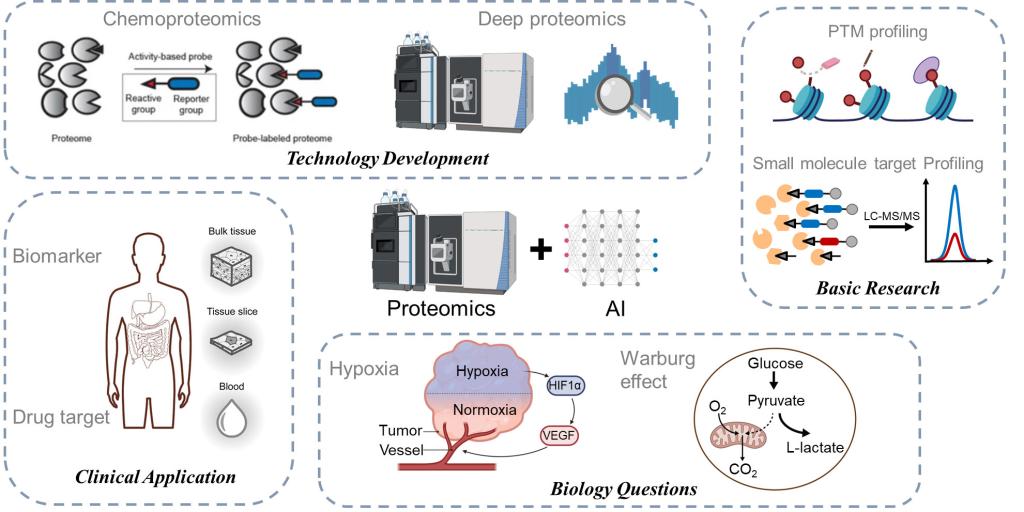
My lab focuses on developing next-generation AI-enabled chemoproteomics technologies to decode protein function and accelerate drug target discovery and drug development. Our research integrates chemical biology, proteomics, and artificial intelligence to advance both technology development and biological discovery. Specific research directions include:
1. Leveraging the power of AI to drive chemoproteomics innovation, enabling deeper, more accurate, and higher-throughput analysis.
2. Utilizing chemoproteomics tools to discover novel protein PTMs and elucidate their regulatory mechanisms in health and disease. Our current work focuses on lysine lactylation and its roles in cancer and neurodegenerative diseases, with the goal of identifying new therapeutic opportunities.
3. AI-driven clinical proteomics. Leveraging AI and large-scale clinical proteomics to identify disease biomarkers and therapeutic targets, providing new strategies for precision medicine and drug discovery.
Representative Publications
Jinjun Gao, Ruilong Liu, Kevin Huang, Ziyuan Li, Xinlei Sheng, Kasturi Chakraborty, Chang Han, Di Zhang, Lev Becker, Yingming Zhao*. Dynamic investigation of hypoxia-induced lysine L-lactylation. Proc Natl Acad Sci U S A. 2025;122:e2404899122.
Di Zhang*#, Jinjun Gao#, Zhijun Zhu#, Qianying Mao, Zhiqiang Xu, Pankaj K Singh, Cornelius C. Rimayi, Carlos Moreno-Yruela, Shuling Xu, Gongyu Li, Yi-Cheng Sin, Yue Chen, Christian A. Olsen, Nathaniel W. Snyder, Lunzhi Dai*, Lingjun Li*, Yingming Zhao*. Lysine L-lactylation is the dominant lactylation isomer induced by glycolysis. Nature Chemical Biology 2025;21:91-99.
Jinjun Gao, Xinlei Sheng, Jianfeng Du, Di Zhang, Chang Han, Yue Chen, Chu Wang*, Yingming Zhao*. Identification of 113 new histone marks by CHiMA, a tailored database search strategy. Science Advances, 2023, 9, eadf141
Jinjun Gao#, Fan Yang#, Jinteng Che, Yu Han, Yankun Wang, Nan Chen, Daniel W. Bak, Shuchang Lai, Xiao Xie, Eranthie Weerapana, Chu Wang*. Selenium-Encoded Isotopic Signature Targeted Profiling. ACS Central Science 2018. 4:960-970. DOI: 10.1021/acscentsci.8b00112
Jinjun Gao#, Yuan Liu#, Fan Yang, Xuemin Chen, Benjamin F. Cravatt, Chu Wang*. CIMAGE2.0: An Expanded Tool for Quantitative Analysis of Activity-based Probe Profiling (ABPP) Data. Journal of Proteome Research. 2021. 10.1021/acs.jproteome.1c00455.
Fan Yang#, Jinjun Gao#, Jinteng Che, Guogeng Jia, Chu Wang*. A Dimethyl-Labeling-Based Strategy for Site-Specifically Quantitative Chemical Proteomics. Analytical Chemistry. 2018. 90:9576-9582. doi: 10.1021/acs.analchem.8b02426