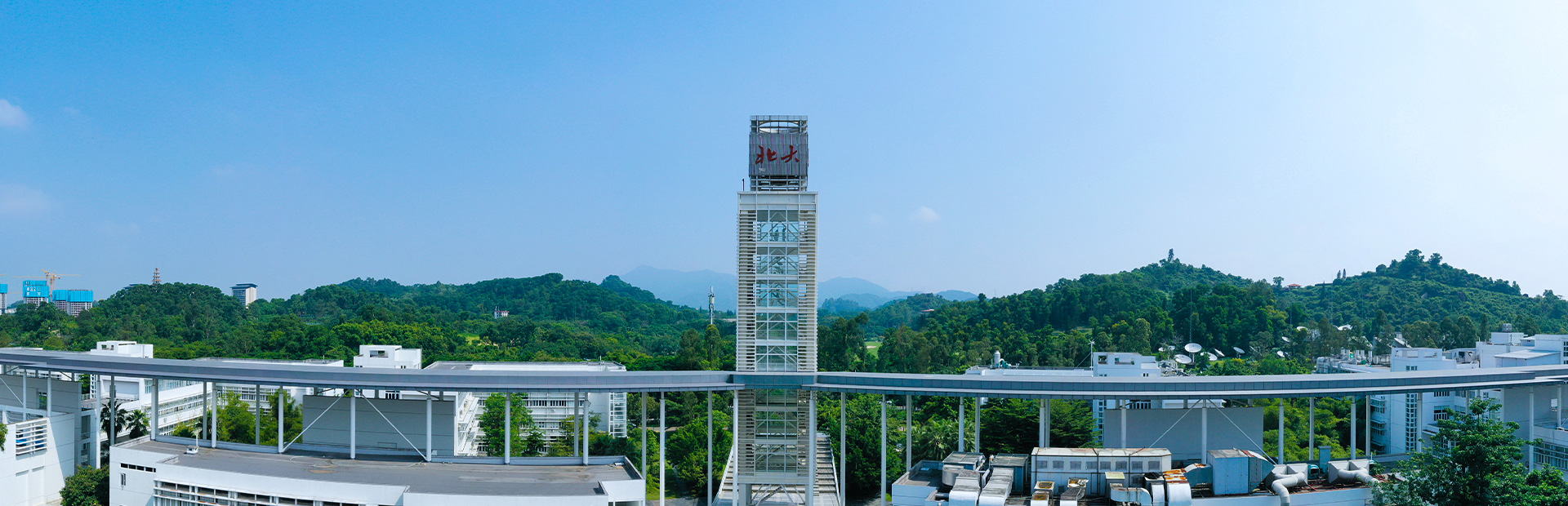
Tang Fu is a 2020 Ph.D. candidate at the School of Chemical Biology and Biotechnology, Peking University Shenzhen Graduate School, under the supervision of Professor Yang Zhen. His research focuses on the total synthesis of natural products. During his doctoral studies, he published papers in the top organic chemistry journal Journal of the American Chemical Society (IF = 15.6) and Tetrahedron Letters (IF = 1.5) as first-author. He is currently undertaking the challenging total synthesis of the complex natural product Phainanoid A. He has received the Peking University May Fourth Scholarship, the Peking University Merit Student Award, and the Peking University Academic Innovation Award, and has twice won the "Outstanding Poster Award" at the Chinese Chemical Society Annual Academic Conferences. He served as president and vice president of the Nanyan Student Kung Fu Association, systematically studying traditional martial arts such as Praying Mantis Fist and Bagua Palm, and actively promoting Chinese culture to international students. In addition, he is passionate about photography, mountaineering, and volunteer service. He earned third place in the 1500m race at the Nanyan "Welcome Cup" Track and Field Meet and was named an "Outstanding Publicity Worker" by Nanyan News Agency. Upon graduation, he will pursue postdoctoral research at a renowned university, continuing his exploration in the realm of synthetic chemistry.
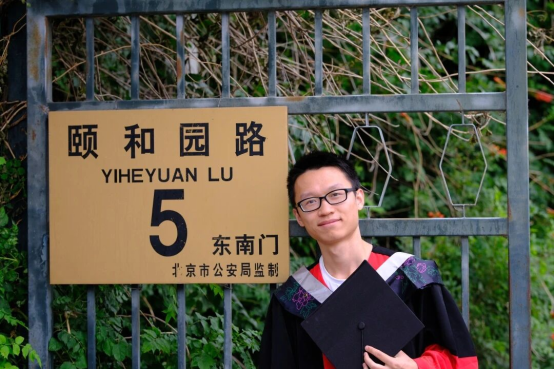
Tang Fu
I. First Arrival at Nanyan Yuan: When Peking University Red Meets Shenzhen Blue
In the summer of 2019, I first set foot on the Nanyan Yuan campus to attend the summer camp of the School of Chemical Biology and Biotechnology. That day, I dragged my suitcase out of Xili Lake Metro Station, and before I had walked far, one of the wheels completely gave out. So there I was—a sweaty young man, lugging a broken-wheeled suitcase all the way from the metro station to Building F of Peking University. Once on campus, I discovered something even more surprising: there were no security gates, and no walls between universities either. You could stroll from Peking University to Tsinghua, then wander over to Harbin Institute of Technology—completely unimpeded. That sense of openness, of permeability, of no barriers, instantly made my earlier ordeal seem trivial. Anday I walked into the lab felt like walking into a room without windows. My hands moved mechanically as I opened the fridge to get reagents; my mind was blank as I shook reaction flasks. I began to doubt myself: Does any of this even make sense? Am I simply not cut out for research?
During that time, my mental state was poor. I had no energy every day—I didn't want to get out of bed in the morning, and once in the lab, I didn't want to move. I even considered switching projects, changing directions—wondering if this path was simply a dead end.
Just when I was at my wit's end, one night I sat alone in the lab, staring into space. Suddenly, a thought flashed through my mind—an idea I had never tried, one that was even a bit "outlandish." It came out of nowhere, like someone striking a match in the darkness. Without overthinking it, I tried it the next morning. To my surprise, within just two weeks, I had obtained the cleanest data I could have hoped for. That was when I truly understood: you have to feel your way against closed windows, again and again, before you can see the door slowly opening.
From then on, I stopped being afraid of failure. I might even say I began to befriend setbacks. Because every time you hit a wall, you're eliminating one wrong path; every fall adds another stone to pave your way to victory. Three months of nothing bought me two weeks of breakthrough momentum. Without all that "useless" work before, that door would never have appeared.
The second thing Nanyan Yuan changed in me was showing me what true excellence looks like. Here, I had the privilege of interacting with many faculty members who have produced significant academic achievements. Yet none of them could be more humble. They work deeply in their fields, year after year, without ever boasting. My advisor, Professor Yang Zhen, is exactly that kind of person. Every time I went to discuss my project with him, he could untie a knot I had been stuck on for months with just a sentence or two. He doesn't give you the answer directly—he points you in the right direction and lets you find the answer yourself. That feeling is truly like a spring breeze—warm, gentle, yet full of strength. More importantly, he never fails to reignite your passion for research. No matter how dejected I felt walking into his office, after talking with him, I would always think, "This problem is actually quite interesting—let me try again." That kind of influence will stay with me for life.
III. Treasures in My Luggage: What I Took from Nanyan Yuan Is Courage
As graduation approaches, if there is one thing I am taking away in my departing luggage, it is courage. Not the slogan-shouting kind, but a very concrete, weighty courage. It comes from the book The Courage to Be Disliked, and also from countless falls and recoveries over these years. It is not just the courage to "stop pleasing others"—it is the courage to walk west when everyone else is heading east.
In the first half of 2025, I finished reading Ichiro Kishimi's The Courage to Be Disliked. The book says that human troubles almost all stem from interpersonal relationships, and the first step to solving them is to break free from others' expectations. That sentence struck me like a needle right in the softest part of my heart. I suddenly realized that I had cared too much about others' opinions—what my advisor thought, how my peers evaluated me, whether reviewers would find fault. I spent too much energy on "what others would think" and forgot to ask myself: "What do I want? What do I think is valuable?"
After all those failures, I still dare to believe in the path I have chosen, and still have the courage to face the unknown tomorrow. That is probably the most precious thing Nanyan Yuan has packed into my luggage.
I once read a passage that really struck a chord: "Fear is human instinct; courage is humanity's anthem." Many times, it's not that we can't do something, but that we're afraid to start—afraid of the uncertain outcome, afraid of others' judgment, afraid of losing. Nanyan Yuan peeled that fear away from me, layer by layer. It made me brave enough to venture into completely unfamiliar territory—for example, when I first studied quantum chemistry with zero background, I just drew mind maps and pored over papers until I got it. It made me bold enough to make friends with people quite different from myself, and to learn martial arts, photography, and video editing outside of my Ph.D. research. These things might seem "useless," but they are precisely what have made my world wider.
Some say that doing a Ph.D. is a process of being constantly negated and then rebuilding yourself. I couldn't agree more. But it is precisely this repeated negation and reconstruction that has made me no longer afraid to "begin." Because I know now that many things are not truly beyond our ability—we are simply afraid to take the first step. What Nanyan Yuan taught me is to step forward bravely—even if you fall, just get back up. What does this courage mean for my future? After graduation, I will do a postdoc and continue working in synthetic chemistry—another choice full of uncertainty. Experiments can fail at any time, directions may shift, competition is fierce. But I am no longer afraid. Because I have already learned one thing: even in uncertainty, you can still move forward.
IV. Looking Back at the Everyday: The Light Boat Has Passed Ten Thousand Mountains
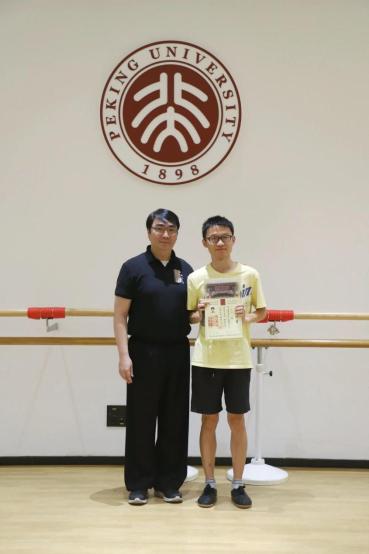
There are many places on the Nanyan Yuan campus, but if I had to pick the one I will miss most, it would be the dance studio on the ground floor of Building 6. Every Sunday morning, the Pksusz student Kung Fu Association trains there—Praying Mantis Fist, Bagua Palm, Baji Quan. Although the beginning was painful, by sticking with it, I genuinely saw my own progress. Over time, I noticed changes: physically, my flexibility improved, my core strength grew stronger, and even the back pain from sitting in the lab all day eased. Mentally, I began to understand what it means to be "controlled and relaxed," to "overcome hardness with softness," to "balance tension and release." One saying from our martial arts teacher has stayed with me: "You all know about spring growth and summer flourishing, but don't forget autumn harvest and winter storage." A person cannot just charge outward all the time—you also need to learn to draw inward. Energy must be allocated, rhythm controlled, if you want to go far.
I brought that principle into the lab. I no longer pushed recklessly as I once did, but learned to plan, to rest, and to "store up" during low periods, conserving strength. Strangely enough, my efficiency actually improved.
Looking back—from that novice in the dance studio to later serving as the association president, leading junior members in training—all I can think of is that line of poetry: The light boat has already passed ten thousand mountains.
V. Walking with Mentors and Peers: Held Up and Ignited
During these years at Nanyan Yuan, I have met many people who helped me. But aside from my advisor Professor Yang Zhen, the ones who influenced me most are Mr. Yang Bosheng and Mr. Xu Ding'an from the pksusz student Kung Fu Association. Our martial arts teachers didn't just teach us forms—they taught us principles for life. They showed me how to balance tension and release, how to take an unconventional approach, and how to apply martial arts philosophy to face and solve challenges in daily life. These words echoed in my mind again and again during my lowest Ph.D. moments, lifting my spirits and giving me strength.
I am also very grateful to my lab mates. A Ph.D. is not a solo battle. Sometimes when reviewers questioned us, my senior and junior lab brothers would come together to analyze the comments and help revise our responses. That feeling of fighting side by side is truly heartening. Later, I also began helping junior students—revising their papers, designing experiments, analyzing data. When I started giving back, I suddenly found my own thinking becoming clearer. "Teaching others sharpens one's own understanding"—that saying couldn't be more true.
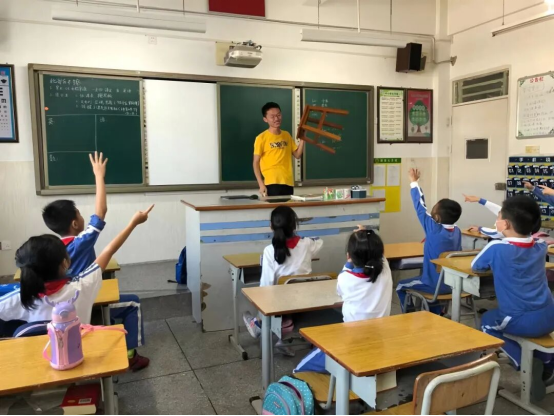
Beyond research and martial arts, I also participated in many volunteer activities at Nanyan Yuan. At the 34th and 35th Annual Academic Conferences of the Chinese Chemical Society, I served as a volunteer for the sub-forums, helping coordinate logistics, manage on-site operations, and process reimbursements. Those days of running around nonstop honed my organizational and communication skills. I also took part in volunteer teaching activities at Pingshan Primary School, writing letters to the children and giving them lessons. Seeing the sparkle in those young students' eyes made me feel that what I was doing truly mattered.
VI. Setting Off Again: Chem Is Try, and So Is Life
After graduation, I will pursue a postdoctoral position and continue working in synthetic chemistry. There is a classic saying in our field: "Chem is try"—chemistry is all about trial and error. I believe life is the same. When you are young, you might as well try different paths, see more of the world, and then come back to decide what kind of life you truly want. In natural product total synthesis, we often try dozens or even hundreds of reaction conditions before finding a viable route. Life is also a total synthesis—there is no standard answer, only constant trial and error and continuous optimization.
This thinking is completely different from when I first started my Ph.D. Back then, I thought that with my patience and decent teaching skills, I'd be fine becoming a high school teacher—stable, with holidays, and the chance to educate others. But now my thinking has changed. I ask myself: now that I have developed some capabilities, can I do more? Can I learn new things and tackle new challenges? During my Ph.D., I published two first-author papers—one in Tetrahedron Letters and one in the Journal of the American Chemical Society, one of the top journals in our field with an impact factor of 15.6. In that paper, we used a rarely reported allene-involved polyene cyclization to efficiently obtain important synthetic intermediates, and then employed high-energy radical intermediates generated through oxidation to achieve E/Z isomerization of alkenes and correctly construct two contiguous all-carbon quaternary stereocenters—a notoriously difficult synthetic feat. The process was extremely tortuous, but it was precisely this complexity that made me fall in love with the thrill of creating something from nothing.
[Images: Tang Fu's papers in JACS and TL]
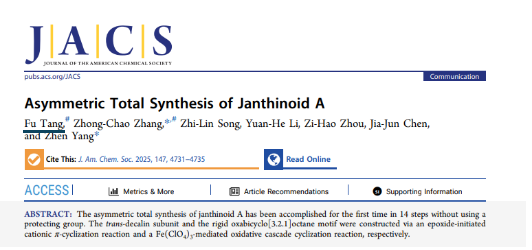
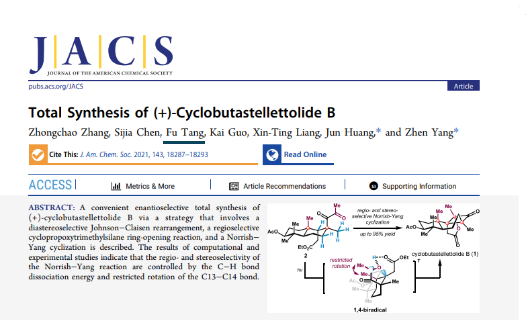
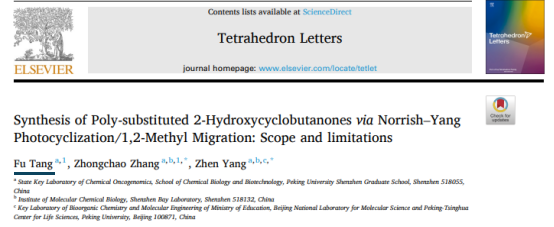
Currently, I am tackling an even more difficult project—the total synthesis of Phainanoid A, a natural product with a ten-ring system. By combining modern computational chemistry to analyze substrate conformations and predict reaction outcomes, we have already made some progress.
These experiences made me realize that I still have potential—I can still climb higher. So I chose the postdoctoral path, continuing my quest in the territory of synthetic chemistry.
I will leave Nanyan Yuan with gratitude. I thank every person here—Professor Yang Zhen, Mr. Yang Bosheng and Mr. Xu Ding'an from the Pksusz student Kung Fu Association, my senior and junior lab mates, and all the faculty at the School of Chemical Biology and Biotechnology. I thank every failure, every late-night discussion, and every sweat-soaked morning in the dance studio. No one can predict the future, but at least I have learned one thing: to face everything with a positive mindset.
I believe in this saying: "Everything will turn out well in the end. If it hasn't, it's not the end."
"Every leave-taking is also an arrival." For me, this means that every farewell is knocking on a new door. You have to let go of many habits and many things you've taken for granted—and that process is painful, like moving in the direction of entropy reduction. But it is only by doing so that you can keep climbing higher and moving forward.
There is one thing I want to take with me but cannot—the sense of time at Nanyan Yuan: the sound of fists cutting through the air in the Sunday morning dance studio, the lights still burning late in the lab, the rustle of pages turning in the library, and the focused, bright-eyed intensity during discussions. These seemingly ordinary things have grown into my bones. Wherever I go in the future, as long as I continue to seriously confront problems, do things with care, and take responsibility for my choices, Nanyan Yuan will always remain in my luggage.