A research team led by Professor Huang Hao, affiliated with Peking University Shenzhen Graduate School and Shenzhen Bay Laboratory, recently published a study entitledISGylation prevents autophagic degradation of STING and promotes antitumor immunity in lung cancerin the journalCell Death & Disease[1].This study reveals the critical role of ISGylation modification in stabilizing the STING protein and enhancing antitumor immunity. Furthermore, it identifies a potential antitumor drug candidate, offering a novel strategy for lung cancer immunotherapy.
ISGylation Stabilizes STING and Blocks Its Autophagic Degradation
The STING pathway plays a central role in mediating antitumor immunity.However, in various cancers including lung cancer, downregulation of STING protein levels frequently compromises the efficacy of immunotherapeutic interventions.Through in-depth investigation, the Huang Hao team discovered thatISGylation(Interferon-Stimulated Gene 15 modification) can significantly stabilize STING protein levels and enhance its immunostimulatory function by preventing it from undergoing autophagic degradation. The study further revealed that the de-ISGylation enzymeUSP18acts as a negative regulator of this process. USP18 removes the ISGylation modification from STING, ultimately targeting it for degradation (Figure 1).
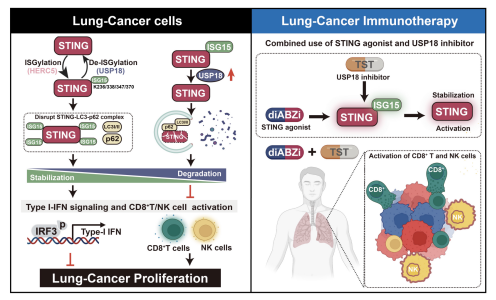
Figure 1: STING ISGylation prevents lung cancer development and progression, while USP18 inhibitors stimulate antitumor immune responses.
Targeting USP18 Amplifies the Antitumor Immune Response
Based on the aforementioned mechanism, the research team identified sodium tanshinone IIA sulfonate (TST) as an effective USP18 inhibitor. Experiments demonstrated that TST inhibits USP18 activity, thereby elevating STING ISGylation levels and sustaining STING protein stability.More importantly, when combined with the STING agonist diABZi, TST exhibited a powerful synergistic effect, effectively triggering a robust antitumor immune response. This discovery not only elucidates the molecular mechanism regulating STING protein homeostasis but also paves a new clinical path for utilizing small-molecule inhibitors to boost STING pathway activity and enhance the efficacy of lung cancer immunotherapy (Figure 1).
Authors and Acknowledgments
The co-first authors of this paper are Dr. Dan Cao (formerly a lab member, currently a postdoctoral fellow at Stanford University) and Dr. Bin Huang (formerly a lab member, currently an associate professor at Harbin Medical University). Other contributors to this study include Xinming Fu, Ming Liu, Xiaogang Niu, andProf.Hongbin Zhai. This research was generously supported by grants from the National Natural Science Foundation of China, the Basic and Applied Basic Research Foundation of Guangdong Province, Shenzhen Science and Technology Projects, and the Shenzhen Bay Laboratory.
Previously, the research group reported that during viral invasion, the deubiquitination of STING mediates the downregulation of host innate immunity [2], proposing a novel strategy for antiviral treatment based on those findings. Taken together, the Hao Huang lab has conducted a series of in-depth and systematic studies centered on the post-translational modification of STING and its role in human innate immune regulation, oncogenesis, and cancer progression. Their innovative therapeutic strategies offer vital theoretical references for the clinical treatment of related major diseases.
References:
[1]Cao D, Huang B, Fu X, Liu M, Niu X, Zhai H,Huang H., ISGylation prevents autophagic degradation of STING and promotes antitumor immunity in lung cancer.Cell Death Dis. 2026 Feb 27;17(2):8527.
[2]Cao D, Duan L, Huang B, Xiong Y, Zhang G,Huang H., The SARS-CoV-2 papain-like protease suppresses type I interferon responses by deubiquitinating STING.Sci Signal. 2023 May 2;16(783):eadd0082.