Chiral amines are ubiquitous in natural products, pharmaceuticals, and various biologically active molecules, and constitute a crucial class of structural motifs. Approximately 40% of small-molecule drugs, along with numerous industrial fine chemicals and agrochemicals, contain chiral amine scaffolds. Consequently, the efficient and highly selective construction of chiral amines has long been a central research focus in synthetic chemistry and medicinal chemistry. Recently, the group of Prof. Jianrong Steve Zhou at the School of Chemical Biology and Biotechnology, Peking University Shenzhen Graduate School, has achieved a series of important breakthroughs in the field of transition-metal-catalyzed asymmetric synthesis, with two research papers published in the top international chemistry journals Angewandte Chemie International Edition and ACS Catalysis, respectively. This extraordinary work has systematically established nickel-catalyzed, highly enantioselective asymmetric reductive addition reactions of aryl, heteroaryl, and alkenyl halides to aldimines, realizing the efficient construction of high-value chiral amines from inexpensive, readily available halides and providing a brand-new strategy for the synthesis of chiral amine compounds.
Since 2000, transition-metal-catalyzed enantioselective arylation and alkenylation of imines has developed rapidly, offering important technical routes for constructing chiral amines. Among traditional methods, copper-catalyzed addition of organometallic reagents to imines, although highly stereoselective, suffers from reagents that are sensitive to moisture and air and require pre-preparation, and shows poor compatibility with functional groups such as hydroxyl and amino groups. Addition reactions catalyzed by precious metals such as rhodium and palladium using organoboron reagents have also developed rapidly, but often require base activation, which limits functional-group tolerance; moreover, the boron reagents themselves are mostly prepared from aryl halides.
In contrast, nickel/cobalt-catalyzed asymmetric reductive arylation and alkenylation of imines can effectively make up for the shortcomings of existing methods and offer a number of outstanding advantages: (1) catalysts based on earth-abundant, low-cost nickel or cobalt; (2) direct use of inexpensive and readily available organic halides or sulfonates as reaction partners, avoiding moisture- and air-sensitive organometallic reagents; (3) mild and neutral reaction conditions with good compatibility toward sensitive functional groups such as nitrogen-containing heterocycles and alcoholic hydroxyl groups; and (4) highly convergent synthetic routes with excellent step economy.
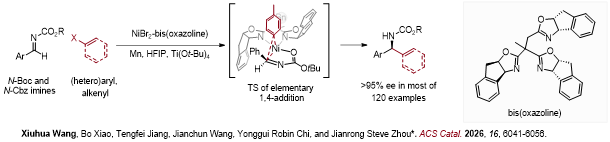
Breakthrough 1: Nickel-Catalyzed Asymmetric Reductive Arylation and Alkenylation ofN-Boc/N-Cbz Aldimines.
Mechanistic studies revealed three key findings. First, cyclic voltammetry experiments indicated that the additive effectively promotes the reduction of nickel intermediates, thereby significantly enhancing the reaction efficiency. Second, DFTcalculations support an aryl nickel(I) species as the active species for insertion, which undergoes bond formation through a novel elementary 1,4-addition mechanism. Third, DFT calculations revealed that the highly stereoselective bis(oxazoline)/nickel catalyst undergoes almost no conformational change from the ground state to the transition state leading to the favored configuration, which closely resembles the“entatic state”feature of metalloenzyme active sites and thus provides new theoretical guidance for the design of chiral metal catalysts.
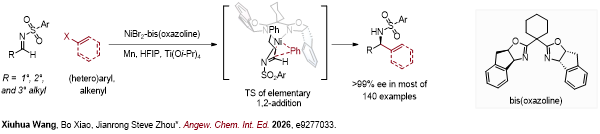
Breakthrough 2: Nickel-Catalyzed Asymmetric Reductive Arylation and Alkenylation ofN-Ts Alkyl Aldimines.
Alkyl aldimines suffer from scientific problems such as low insertion activity, difficult stereoselective control, and lack of mechanistic understanding: in particular, the weak electronic effect of primary alkyl substituents leads to insufficient polarization of the C=N bond, resulting in high insertion barriers and low reaction efficiency; their small steric hindrance and high conformational freedom make entropic effects on the transition state significant, leading to poor enantiofacial differentiation of imines and difficult stereoselective control. This is a common scientific challenge in the field of catalytic addition. The research team reported the use of rigid chiral bis(oxazoline) nickel complexes to efficiently catalyze asymmetric reductive addition of aryl, heteroaryl, and alkenyl halides toN-sulfonyl alkyl aldimines. The method has an extremely broad substrate scope, covering more than 80 (hetero-)arylation products and more than 60 alkenylation products, with the vast majority of chiral amine products obtained in enantiomeric excess (ee) values of >99%. The new method is not only applicable to imines bearing primary alkyl groups, but also compatible with sterically hindered substrates such as secondary alkyl and tert-butyl groups, while exhibiting excellent functional group tolerance; sensitive groups such as alcohols, esters, phthalimides, carbamates, free indoles, and pyridines are all tolerated.
The reaction proceeds efficiently with only 1 mol% nickel catalyst and has been successfully scaled up to gram scale. The research team applied the method to the concise synthesis of 10 medicinally relevant chiral benzylamines and azacycles, including aβ3adrenergic agonist, a nicotine analogue, and key intermediates of drugs such as BMS-394136. In addition, the method can also be used for the synthesis of cathinone derivatives—compounds found in nature with neuroactive properties, whose stereochemistry significantly affects their target selectivity.
DFT calculations revealed that the insertion active species is aryl nickel(I), which forms bonds through a classical 1,2-insertion reaction.
These two works systematically expand the methodological boundaries of nickel-catalyzed asymmetric reductive addition, fromN-Boc/N-Cbz aldimines toN-Ts alkyl aldimines, and from arylation to alkenylation, constructing a chiral amine synthesis platform with broad substrate scope, high enantioselectivity, and good functional group compatibility. The methods directly use inexpensive and readily available organic halides as electrophiles, avoiding the preparation and use of organometallic reagents and organoboron reagents; the reaction conditions are mild and neutral, the operations are simple, and the methods have significant practical value.
The first author of the above two research works is Xiuhua Wang, a PhD student at Peking University (contributed in experimental work); Dr. Bo Xiao from Shenzhen Polytechnic University is the co-first author (contributed in mechanistic calculations); Prof. Jianrong Steve Zhou is the corresponding author. This research was supported by the National Natural Science Foundation of China (22671009, W2431014 and 22271007,22603088), Peking University Shenzhen Graduate School, the Shenzhen Bay Laboratory Supercomputing Center, and the Research Fund of Shenzhen Polytechnic University(6025310040K).
Paper Information
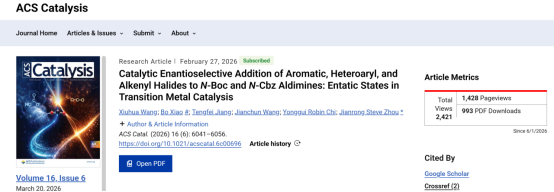
1. Catalytic Enantioselective Addition of Aromatic, Heteroaryl, and Alkenyl Halides toN‑Boc andN‑Cbz Aldimines: Entatic States in Transition Metal Catalysis.
ACSCatal.2026,16, 6041-6056.https://doi.org/10.1021/acscatal.6c00696.
2. Nickel-Catalyzed Enantioselective Addition of Aromatic, Heteroaryl, and Alkenyl Halides to Aliphatic Aldimines.Angew. Chem. Int. Ed.2026, e9277033.
https://doi.org/10.1002/anie.9277033