Under the Belt and Road Initiative, China-Africa scientific and educational exchange serves as a vivid embodiment of mutual learning among civilizations and an important bond of South-South cooperation. To promote dialogue and connectivity between Chinese and Tanzanian research institutions andtoexplore feasible paths for transnational joint research and joint cultivation of young talent, on September 28, 2026, a delegation of scholars from the Nelson Mandela African Institution of Science and Technology (NM-AIST) in Tanzania visited the School of Chemical Biology and Biotechnology (hereinafter referred to as the "SCBB") at Peking University Shenzhen Graduate School. The delegation included Professor Hulda Shaidi Swai, Dr. Elingarami Sauli Nkya, and Erick Amos Msafiri (Li Yiqian), an MSc student. Through panel discussions, academic seminars, and on-sitevisits to research platforms, the two sides conducted in-depth exchanges on their respective research fields and future cooperation.
The panel discussion was held in the morning. Professor Li Zigang, Executive Dean of the SCBB, extended a warm welcome to the Tanzanian scholars. The two sides introduced the development overviews and key research directions of their respective institutions and jointly explored potential entry points for cooperation. After the discussion, the two sides took a group photo.
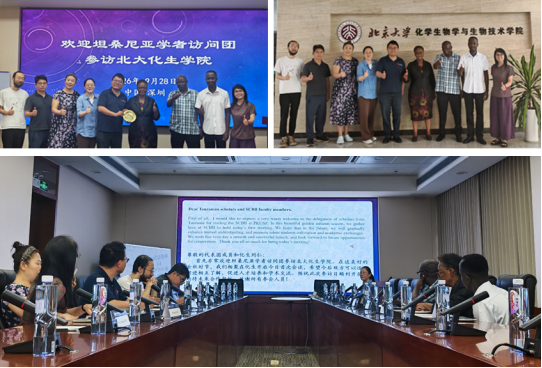
The two sides hold a panel discussion.
During the academic exchange session, the visiting scholars engaged in academic exchanges and seminar interactions with the research groups led by Professor Li Zigang and Professor Jiang Yanlong. The two mentors shared their research groups' representative scientific achievements and frontier exploration directions in the field of chemical biology, and participants interacted fully around relevant research topics, exchanging academic insights.
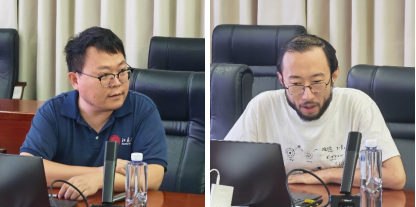
Professor Li Zigang and Professor Jiang Yanlong giving introductions
In the afternoon, the delegation successively visited the School's Laboratory Animal Center, Instrument Center, and the laboratories of the research groups led by Cao Yu and Jiang Yanlong.
At the Laboratory Animal Center, staff members including Zhuo Zhenjian, Liao Wenfeng, and Zeng Rufeng introduced the center's operational overview, management system, and construction achievements to the delegation, led the guests on an on-sideobservation of the animal breeding platform, and the two sides held thorough discussions on practical experience in standardized management of laboratory animals.
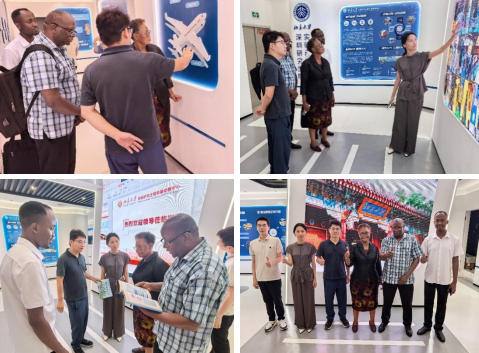
Visiting the Laboratory Animal Center
At the Instrument Center, engineersincluding Zhou Liyan, Huang Yangmei, Zhang Lele, Li Lin, and Xie Hao provided detailed instructions of the diverse large-scale instruments in the fields of biology and chemistry at the School and demonstrated the operation and application of some equipment on site. In response to the delegation's questions about instrument operation and maintenance and the open sharing of platform, the engineersanswered each questioone by one, enabling the visiting scholars to gain an intuitive understanding of the school’s strength in high-level research.
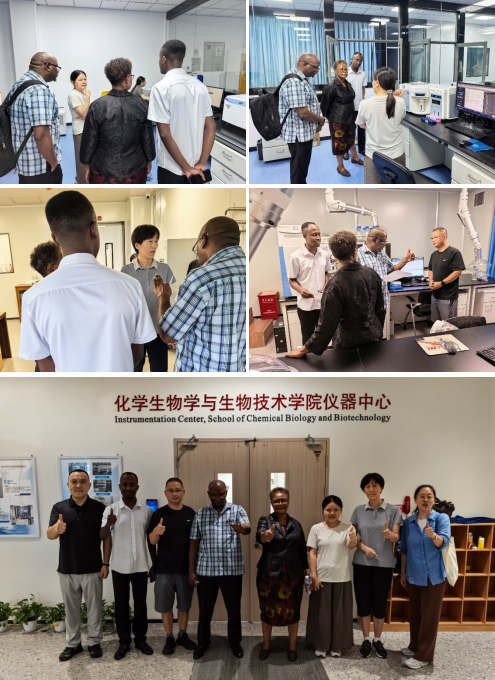
Visiting the Instrument Center
The delegation finally entered the laboratories of the Cao Yu and Jiang Yanlong research groups. Student representatives from the research groups introduced the main research content and scientific equipment of the laboratories and demonstrated how daily scientific research work is carried out. The Tanzanian scholars engaged in in-depth exchanges with the students based on their own research fields and gave full recognition to the students' presentations and practical research capabilities.
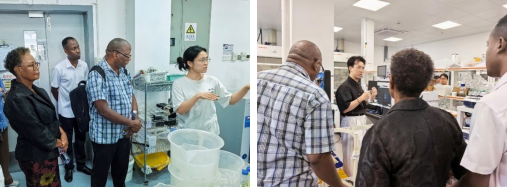
Visiting the laboratories of the Cao Yu and Jiang Yanlong research groups
This visit marked the first time SCBB had hosted a delegation of scholars from an African country since it was established.It is an active practice of the School in expanding international scientific and educational exchange and serving the joint construction of the Belt and Road Initiative. The event effectively narrowed the academic distance between the two sides and laid a solid foundation forthesubsequent advancement of research collaboration and talent cultivation exchanges.
Based in Shenzhen, a leading innovation hub,the SCBB will continue to embrace an international cooperation philosophy of openness, inclusiveness, and mutual benefit, and will continue to expand its global academic "circle of friends." In the future, the School will continue to deepen linkages with the Nelson Mandela African Institution of Science and Technology and other research institutions along the Belt and Road, exploring practical paths for academic exchange, joint research, and talent cultivation, and continuously contributing Peking University's wisdom and strength to deepening China-Africa scientific, educational, and cultural exchange and promoting the steady and enduring advancement of South-South scientific and technological cooperation.
Photography: Wang Yubo, An Xiaoyan
Writing: An Xiaoyan