To enhance the scientific research literacy of all students, promote academic exchange, and deepen cross-laboratory collaboration, and with the support of Peking University's "Graduate Education Innovation Program," the 4th Doctoral Academic Conference on Disease Target Research and Novel Drug Discovery was officially opened on the morning of June 25, 2026, in the Lecture Hall of Building D,Peking University Shenzhen Graduate School. The conference was co-hosted by the School of Chemical Biology and Biotechnology(SCBB), Peking University Shenzhen Graduate School; the College of Chemistry and Molecular Engineering, Peking University; the School of Life Sciences, Peking University; andthe School of AI for Science, Peking University. It was organized by the Graduate Student Association of the School of Chemical Biology and Biotechnology.
Conference Opening
Attendees included Prof. Li Zigang, Executive Dean of the SCBB; Prof.Quan Junmin, Associate Dean of the SCBB;keynote speakersProfessor Chen Hongbo, Associate Dean of the School of Pharmacy, Sun Yat-sen University; Researcher Lin Xiaolu from DPTechnology; as well as faculty and students from theSCBB.
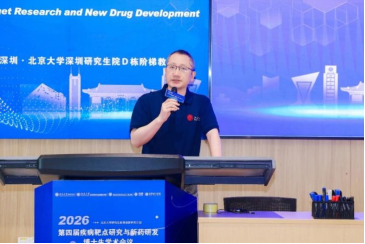
Associate Dean Prof.Quan Junmin delivering the opening address
Associate Dean Prof. Quan Junmin delivered the opening remarks. He extended a warm welcome and sincere gratitude to Prof. Chen Hongbo and Researcher Lin Xiaolu for their presence, and conveyed his cordial greetings to all colleagues and young scholars in attendance. Professor Quanhighlighted that the essence of academia lies in inheritance, the value of research lies in exchange, and cutting-edge breakthroughs often arise from cross-disciplinary intellectual collision. This conference aims to break down barriers and build an open-minded and equal platform for academic dialogue, where diverse perspectives can converge and thrive. He encouraged students to cherish the opportunity to present their work, treating every presentation and critical question as a chance for growth. He also hoped that all participants would speak freely, focus on key industry challenges, and that students would present with confidence while acknowledging their limitations, cultivating rigorous and truth-seeking scientific attitudes through mutual discussion.
This conference adhered to the School's core mission of original innovation and breakthrough technologies, as well as its educational philosophy of interdisciplinary integration across "Chemistry—Biology—Medicine." Against the backdrop of the growing Chemical Genomics discipline and the era of big data, the conference emphasized the deep integration with artificial intelligence to reshape students' critical thinking and innovative capabilities, aiming to cultivate graduate students with cutting-edge innovation skills and an international perspective. The academic exchanges covered invited keynote talks on drug discovery innovation and AI-driven paradigms in drug R&D, as well as student presentations.
Invited Talks
1. Development of Novel Immunomodulators Based on New Targets
Organ transplantation remains the last hope for many patients with end-stage diseases, but transplant rejection continues to threaten recipient survival and quality of life. Professor Chen Hongbo's team at Sun Yat-sen University has focused on the mechanisms of transplant immune rejection and new pathways to immune tolerance, aiming to discover novel therapeutic targets and develop new immunosuppressants based on these targets. Using genetic library screening, the team revealed for the first time a novel mechanism by which the nucleolus regulates T-cell activation, and repurposed the anticancer drug "CX-5461" to inhibit transplant immune rejection, achieving a drug repurposing. Additionally, the team identified immune checkpoint molecules as key players in inducing transplant tolerance and designed novel immunomodulatory formulations based on cell membranes and exosomes. Recent studies also suggest that gut microbiota dysbiosis is closely linked to transplant rejection, offering new perspectives for clinical early diagnosis and intervention. These original findings are bringing new possibilities for long-term survival of transplant patients.
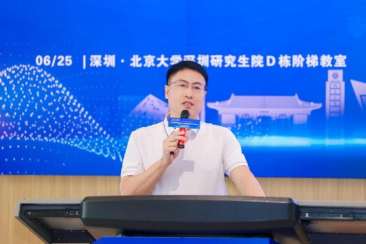
Invited talk by Professor Chen Hongbo,
Associate Dean of the School of Pharmacy, Sun Yat-sen University
2. Building with Computation, Breaking Through with Intelligence: AI Agents Reshaping the New Paradigm of Drug Discovery
As AI agents evolve from passive question-answering to actively invoking tools, executing tasks, and orchestrating end-to-end workflows, drug discovery is reaching an inflection point in efficiency. Researcher Lin Xiaolu from DPTechnology shared that their team has built a full-chain technical capability encompassing structure modeling, virtual screening, free energy calculation, molecular generation, and patent analysis, leveraging the Hermite drug computing platform and the PharmMaster agent platform. Within the Hermite ecosystem, Uni-Fold and Uni-EM precisely resolve protein structures and target mechanisms; Uni-Dock, accelerated by GPUs, enables high-throughput screening of tens of millions of compound libraries within hours; Uni-FEP predicts activity changes with chemical accuracy of ±1 kcal/mol, providing reliable guidance for lead optimization; and Uni-VDGen, Uni-Aquasite, and Uni-QSAR/ADMET empower molecular generation, water molecule analysis, and drug-likeness evaluation, respectively. PharmMaster, as the upper-layer agent, integrates these computational tools with vast literature, patents, and experimental data, autonomously executing target investigation, patent analysis, molecular optimization, and even dry-wet closed-loop decision-making, forming an actionable and verifiable intelligent R&D loop. Researcher Lin noted that from mining millions of patents to full-process molecular optimization, the hit identification phase, which traditionally took months, has now been compressed to within two weeks. Drug discovery is transitioning from a "human-orchestrating-tools" craft model to a standardized, industrialized, and self-evolving new era.
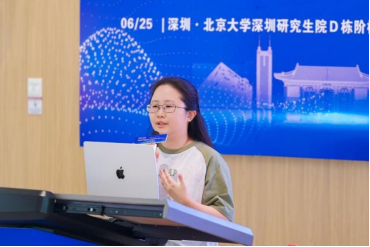
Invited talk by Researcher Lin Xiaolu from DPTechnology
Student Presentations
Student presentations were organized into four thematic sessions: AI for Science, Target Discovery and Mechanism of Action Studies, Drug R&D, and Exploration of Disease Treatment Approaches.
Wang Yubo presented a multi-agent system that efficiently integrates vast literature and automatically generates scientific hypotheses, providing an intelligent new tool for research topic selection and knowledge discovery. Hu Chengpeng used virtual cell models to systematically explore new pathways for immune regulation and aging intervention, expanding the translational potential of computational biology in medicine. Zhu Hong proposed the AMINN method, which uses neural networks to correct integral terms in semi-empirical methods, significantly improving computational accuracy and efficiency. Jiao Zijun demonstrated a sequence-based generative AI algorithm, opening new avenues for the rapid discovery and design of cyclic peptide drugs. Collectively, these works showcase the cross-disciplinary innovative vitality of AI-driven life sciences and drug research.
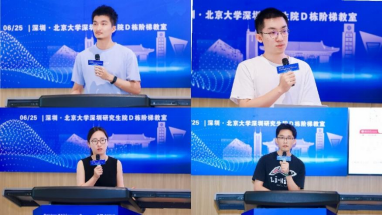
Student presentations in the AI for Science session
In the ‘Target Discovery and Mechanism of Action’ session, several students shared recent breakthroughs in exploring targets for neuropsychiatric disorders. Hu Yehong focused on the disinhibitory microcircuit in the anterior cingulate cortex, revealing how this circuit mediates experience-dependent social empathy behavior, providing new clues for understanding the neural basis of social cognition. Hu Yue, working on the P2Y6 receptor, elucidated its role in mediating neuronal autophagy in the pathological process of depression, offering a potential new target for antidepressant development. Dai Xiaoyan systematically demonstrated the bidirectional regulatory function of the ADGRA1 gene (from the 10q26.3 locus) on emotional behavior, expanding our understanding of the genetic regulatory network underlying affective disorders. These three studies deepened our understanding of target mechanisms from different levels, laying a solid foundation for future intervention strategies.
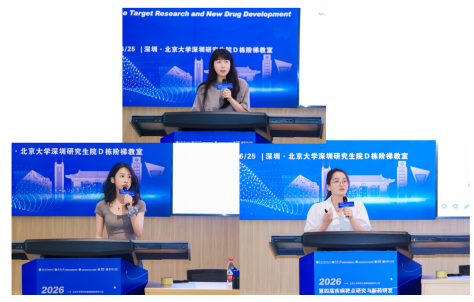
Student presentations in the Target Discovery and Mechanism of Action session
In the "Drug R&D" session, students presented diverse innovations ranging from synthetic methods to molecular design. Wang Xiuhua developed a nickel-catalyzed asymmetric reductive addition of imines, providing a green and efficient route for constructing chiral amine drugs. Wang Yuechen designed multifunctional protein degraders based on a "Split-and-Mix" strategy, achieving precise knockdown and functional regulation of target proteins. Tang Fu focused on the total synthesis of the natural product Phainanoid A, overcoming the challenges of constructing its complex skeleton through ingenious synthetic routes. These works demonstrate the deep integration of organic synthesis and medicinal chemistry, injecting strong momentum into the original innovation of lead compounds.
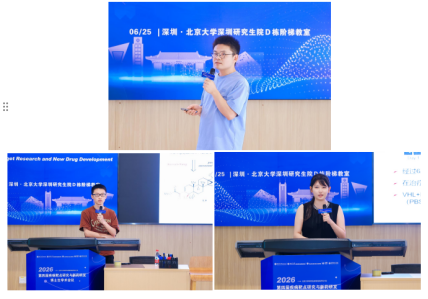
Student presentations in the Drug R&D session
In the "Exploration of Disease Treatment Approaches" session, students proposed several cutting-edge strategies targeting tumor immunity and targeted therapy. Liu Xueqing discovered that the small molecule K01, which targets the activated state of astrocytes, can effectively inhibit glioma progression, revealing a novel non-tumor cell intervention strategy in the glioma microenvironment. Xu Huidong designed a conditionally activated CD3×EGFR bispecific antibody that enhances anti-tumor safety and efficacy through tumor microenvironment-specific activation. Song Chunli constructed modular nanobridges that can synergistically recruit multiple immune cells to achieve potent combination immunotherapy against solid tumors. These three studies, from the perspectives of cell biology, antibody engineering, and nanotechnology, enriched the toolkit for cancer therapy and demonstrated the broad prospects of translational basic research.
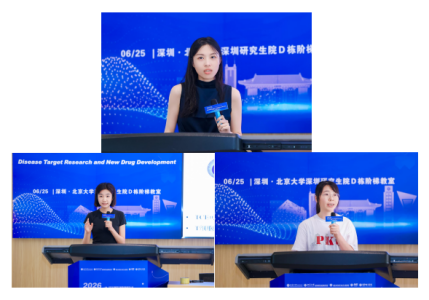
Student presentations in the Exploration of Disease Treatment Approaches session
Award Ceremony and Closing
After intense competition, the conference selected 1 first prize, 3 second prizes, 5 third prizes, and 5 excellence awards, with 2 Best Presentation Awards chosen by the audience.
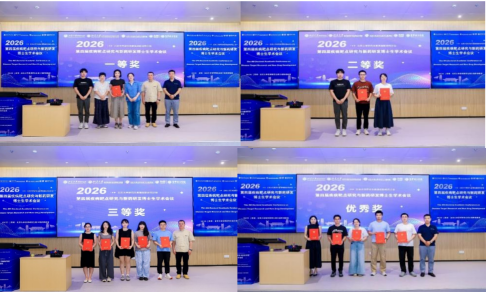
Award ceremony for student presentation winners
Representatives from the scholarship-sponsoring companies also attended to present certificates to the college scholarship recipients, in recognition of their diligent academic pursuits.
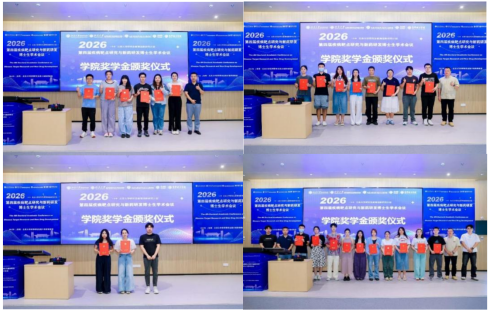
Award ceremony for college scholarship recipients
The conference concluded with a farewell ceremony for the Class of 2026 graduates, wishing them well as they initiate on a new chapter in their life trajectory.
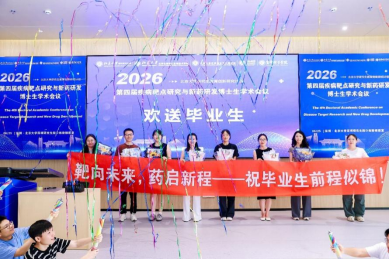
Farewell to the graduating students
The Doctoral Academic Conference provides a systematic platform for graduate students, supporting the consolidation of phased research outcomes, fostering in-depth academic exchange, and stimulating opportunities for cross-disciplinary collaborative innovation. By presenting their research progress and engaging in thorough discussions, students received many constructive suggestions to further advance their work. At the same time, the conference helped deepen their theoretical frameworks, refine their thesis structures, and systematically enhance the rigor and innovation of their academic outputs. In the future, theSCBBwill continue to build excellent platforms for students, guiding them to integratecomprehensive thinking and exploration into their research endeavors.