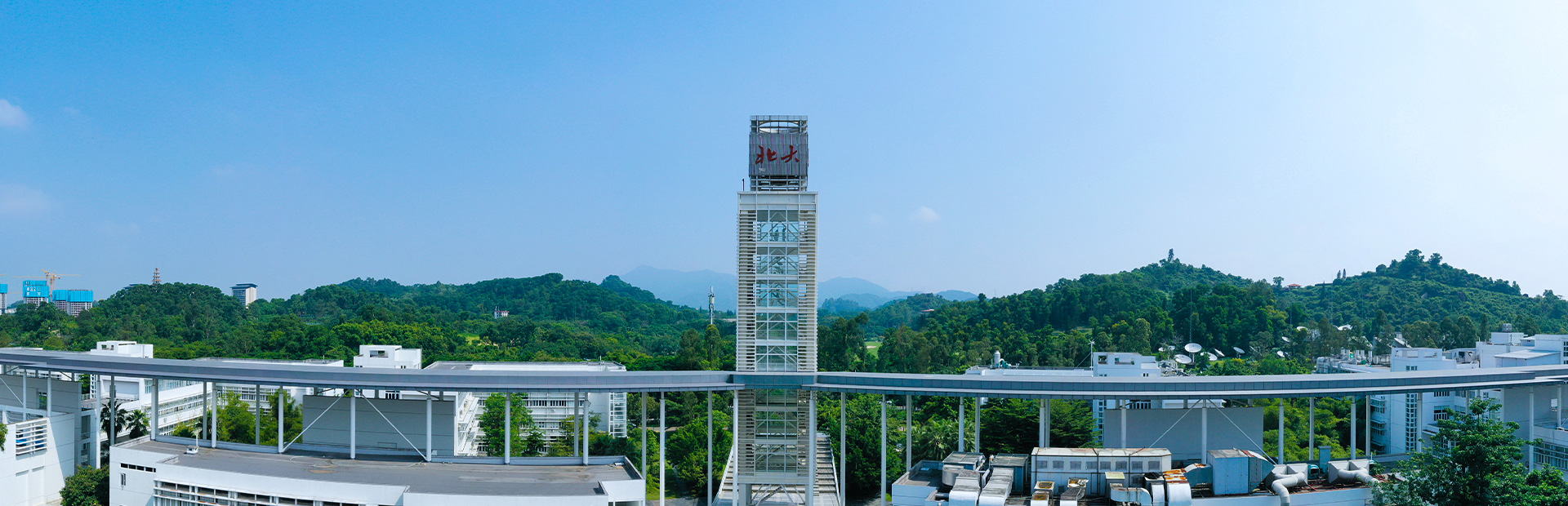
To deepen academic collaboration and broaden scientific research horizons, Professor Guofu Zhong from the Department of Science at the Eastern Institute of Technology (EIT), Ningbo, visited the school on April 23, 2026,viathe invitation of Professor Hongbin Zhai. During his visit, Professor Zhong delivered an insightful academic lecture titledFrom Antibody Catalysis to Organocatalysis and the Construction of Chiral Aryl Ethers.
Focusing on the critical scientific issue of the efficient acquisition of chiral small organic compounds in synthetic organic chemistry, Professor Guofu Zhong initially traced the origin and evolution of organocatalysis, summarizing its theoretical and practical development history. Taking the pioneering field of antibody catalysis as the main storyline, antibody catalysis was realized through the design of enzyme transition state mimics, successfully verifying the conception of customized catalysts.
Concurrently, he noted that the cumbersome preparation and high cost of antibody catalysis restricted its application, thereby indirectly promoting the advancement of organocatalysis. From the turn of the 21stcentury to the present, small organic molecular catalysts with relatively simple structures, concise synthetic processes, and broad sources have boomed. Small-molecule organocatalysis has not only successfully inherited the core intelligence of antibody catalysis but has also displayed powerful potential in asymmetric synthesis.
Lastly, Professor Zhong discussed the construction of chiral aryl ethers,a class of structural units featuring a chiral center where an aromatic ring is bonded to an oxygen atom,which represents a frontier academic field of organocatalysis, and expounded on its theoretical significance and application potential in asymmetric catalysis. At the end of the report, Professor Zhong demonstrated in detail his team's latest research results and breakthrough progress in the field of chiral aryl ether framework construction, providing new research ideas and technical references for the audience.
Following the presentation, the audience engaged in an active Q&A session focusing on core topics such as the optimization of catalytic mechanisms and the applications of chiral compound synthesis. Professor Zhong answered each question with patience and detail, fostering a vibrant and enthusiastic atmosphere for academic exchange.
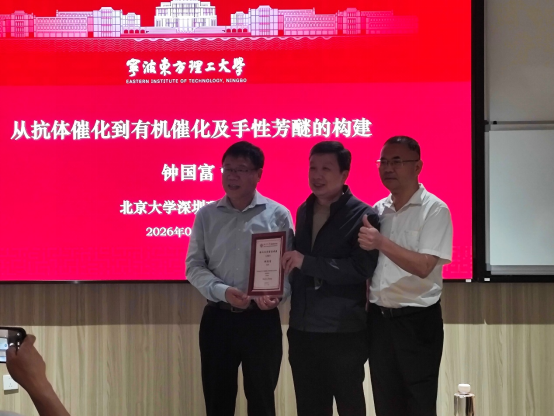
This academic exchange activity not only allowed thefacultyand students of our school to deeply understand the cutting-edge dynamics and research hotspots in the field of organocatalysis,but also built a high-quality bridge for inter-institutional academic communication,integratingfresh vitality into the innovation and development of related disciplines at the school. At the end of the event, Professor Zhen Yang presented Professor Guofu Zhong with a commemorative lecture plaque custom-designedby Peking University Shenzhen Graduate School, bringing the academic event to a successful close amidst warm applause.
Guest Biography
Guofu Zhong is currently a Professor in the Department of Science at the Eastern Institute of Technology, Ningbo. He was selected as a Changjiang Scholar Distinguished Professor by the Ministry of Education in 2004 and elected as a Fellow of the Royal Society of Chemistry (FRSC) in 2021. He received his Bachelor's, Master's, and Ph.D. degrees from the Nanjing University of Science and Technology, East China University of Science and Technology (ECUST), and The Scripps Research Institute (USA), respectively.
Professor Zhong has previously held faculty and research positions at ECUST, the University of Lausanne (Switzerland), The Scripps Research Institute, Fudan University, Nanyang Technological University (Singapore), and Hangzhou Normal University. His research focuses on synthetic organic chemistry, asymmetric catalysis, and medicinal chemistry. To date, he has published over 170 SCI-indexed papers, with his achievements featured multiple times inChemical & Engineering News (C&E News). Notably, his pioneering work in the field of asymmetric aminoxylation was specially featured by the German review journalSynFormin 2011.
In terms of applied research, he has applied for more than 30 domestic and international patents and successfully commercialized two technologies. In talent cultivation, the students under his guidance have received numerous accolades, with nearly 50 recipients of prestigious domestic and international awards, including the Chinese Government Award for Outstanding Self-Financed Students Abroad, the Alexander von Humboldt Fellowship, the Reaxys PhD Prize Finalist, and the World Future Foundation (WFF)PhD Prize.