To help faculty seize opportunities presented by AI technological transformation and enhance the efficiency and quality of the entire teaching process, on the afternoon of 8 May 2026, the School of Chemical Biology and Biotechnology, Peking University, invited Professor Chen Jiang from the School of Electronics Engineering and Computer Science, Peking University, to deliver a special lecture on “Practical AI Teaching Skills” in Lecture Hall C105 at Nanyan. Professor Chen Jiang is a recipient of Peking University’s Teaching Excellence Award and one of the Top Ten Teachers, and has long served as a training expert at the Faculty Teaching Development Centres of both Peking University and Tsinghua University, with extensive practical experience in teaching innovation. The lecture focused on the diverse applications of AI in teaching scenarios and attracted many faculty members and students from the School, generating enthusiastic on-site responses.
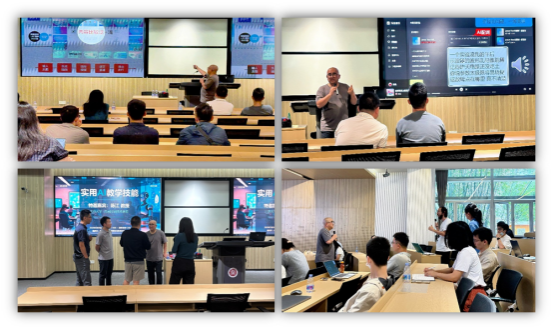
Professor Chen Jiangsharedpractical AI teaching skills and interactive Q&A
Professor Chen Jiang opened the lecture with a humorous and engaging introduction, highlighting the profound impact of AI technology on traditional teaching models. He pointed out that over the past three years, the iterative development of new AI technologies such as ChatGPT has been driving innovation across all aspects of teaching—including lesson preparation, classroom interaction, and post�class enhancement. Centred on this theme, the lecture combined principle explanations, live demonstrations, and on�site guidance to help teachers overcome several key “thresholds” and quickly master practical AI tools, thereby acquiring novel teaching methods that are difficult to achieve through traditional approaches. With vivid examples and witty language, Professor Chen made seemingly complex AI tools accessible and approachable, drawing frequent knowing laughter from the audience.
In the session on preparing courseware materials, Professor Chen focused on AI applications in PPT creation. Addressing common challenges teachers face in PowerPoint production, he demonstrated how to efficiently use AI for text optimisation, layout assistance, and other tasks, freeing instructors from tedious material collection and formatting processes and enabling them to quickly producewell-structured,content-rich, and visually appealing teaching slides. In image generation, he showcased how AI can rapidly generate visuals that match course themes, providing strong support for visualising abstract knowledge points. For audio applications, he introduced practical methods for generating course explanation audio and synthesising multilingualvoice-oversusing AI. In the video production segment, he demonstrated the full workflow ofAI-assistedcreation of instructional demonstration videos and animated explanatory clips, offering more diverse formats for classroom introductions and knowledge presentations and breaking the limitations of traditional one�dimensional teaching.
Classroom interaction was one of the core topics of the lecture. Professor Chen presentedcase-baseddemonstrations of AI�enabled interactive teaching methods and in�class assessment tools: using AI to respond to student questions in real time, generate interactive quiz questions, administer mini�tests, and rapidly analyse results—helping teachers accurately gauge students’ learning status, transcend the spatial and temporal constraints of conventional classroom interaction, make interactions more targeted and engaging, and effectively boost student participation. In addition, Professor Chen sharedAI-basedsolutions for course review and after�class tutoring assistants, offering practical approaches to optimise the closed loop of teaching. During the Q&A session, he patiently and thoroughly addressed the challenges teachers raised regarding the use of AI tools, fostering a relaxed and lively atmosphere, with both faculty and student attendees gaining substantial insights.
At the conclusion of the lecture, Vice Dean Peng Tao of the School of Chemical Biology and Biotechnology presented Professor Chen Jiang with a commemorative plaque, expressing sincere gratitude for his wonderful presentation. Professor Chen’s lecture was rich in content, vivid in examples, and humorous in style. It not only conveyed practical AI teaching skills but also inspired faculty members’ thinking and courage in teaching innovation—truly a high�quality, high�level academic exchange event.
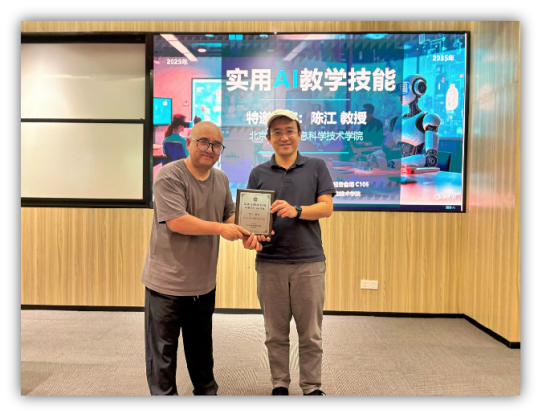
Vice Dean Peng Tao of the SCBBpresenting a commemorative plaque to Professor Chen Jiang
This special lecture provided an excellent platform for faculty members to learn about and exchange ideas on AI teaching skills, helping them systematically understand practical methods for applying AI in areas such as PPT production, image generation, audio�visual material preparation, classroom interaction, and post�class review. In the future, the School will continue to monitor trends in digital and intelligent teaching development, organise more targeted AI skills enhancement activities, promote innovation in teaching methods and improvement in teaching quality, and comprehensively empower the cultivation of high�level talents.
Written by: Wu Jiaxing, Li Rui
Photography by: Li Rui